The global taxi and ride-hailing market continues to expand rapidly. A recent analysis predicts the online taxi services market will grow from $43.72 billion in 2024 to $48.72 billion in 2025. By 2030 nearly 974 million people are expected to use taxis worldwide. This growth is driven by customer demand for fast, convenient bookings and real-time tracking. Modern taxi booking platforms typically comprise a customer mobile app, a driver app, and an admin dashboard. They offer features like on-demand and scheduled rides, dynamic pricing, in-app payments, and analytics. In short, the right software can streamline dispatch, improve driver utilization and boost revenue for taxi operators.
In this guide we profile two leading solutions – Taxido and TaxiRide (Pixelstrap) – then compare them to major competitors. We’ll highlight core features, tech stacks, pricing models, pros/cons and target users. A comparison table summarizes key differences (features, pricing, integrations, scalability, ideal use-case). Finally, we present a buyer’s checklist covering must-have vs optional features, implementation steps, cost breakdowns (license vs subscription vs customization vs maintenance), ROI considerations, and migration tips. Wherever possible we draw on official vendor info and recent (2023–2026) expert sources. This post is written from a buyer’s perspective and ready for publication (UK-English).
Modern taxi-dispatch software (sometimes called “taxi booking” or “cab management” software) enables customers to book and track vehicles via mobile apps or web, while operators manage fleets and drivers through a backend system. Key market trends include AI-driven dispatch, multi-service apps (adding rentals, parcel or freight bookings), and support for emerging mobility models (shuttle, chauffeur services, etc.). Taxi booking systems bring several benefits: they reduce waiting times, automate dispatch, open new booking channels (app, web, call centre, even WhatsApp), and enable analytics. For example, industry commentary notes that adopting the right dispatch platform can “cut overhead costs, boost profit margins, and build long-term trust with customers”. Conversely, mismatched software leads to inefficiencies, frustrated drivers and customer churn.
In our view, the best taxi booking platforms for 2026 will be those offering: real-time GPS tracking and routing, multiple booking channels (passenger app, web booking, call intake), integrated payment processing, and flexible administration (mapping, pricing rules, reporting). Other emerging must-haves include AI/automation for dispatch, white-label (branded) apps, multi-currency/lingual support, and features like scheduling, loyalty, or chat. We explore these in more depth later.
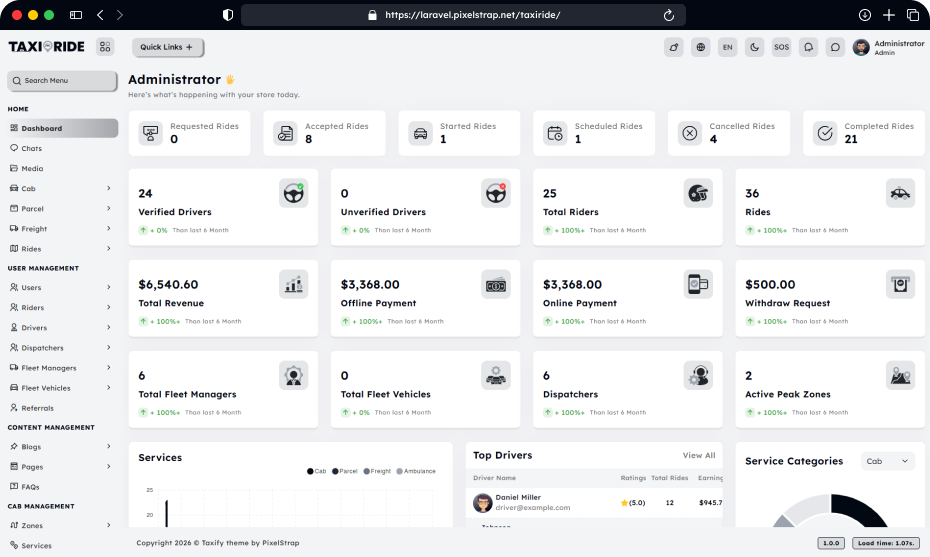
This guide examines two ready-made solutions (Taxido and TaxiRide) with full feature sets, then compares them to well-known global players. Our analysis draws on official product pages, vendor documentation and recent reviews. We also include screenshots of the products (see below), an integrated feature comparison table outlining a typical purchase-to-deployment timeline. All key claims are sourced to authoritative references.
Taxido (by Pixelstrap) is marketed as “your all-in-one taxi booking platform”. It’s a React Native/Laravel-based ride-hailing solution with apps for riders and drivers plus an admin panel. Taxido supports on-demand and scheduled taxi trips, as well as value-added services like vehicle rentals, parcel delivery and freight transport. Typical use-cases include traditional taxi fleets, private hire operators, or businesses wanting a branded booking system (like hotel shuttles).
Key features of Taxido include: multi-channel booking (mobile app, web, call centre), live map-based dispatch, multiple service types (ride, rental, parcel, freight, bids), scheduling and recurring bookings, coupon codes and wallet/payments, driver management (vehicle registration, availability toggle, earnings withdrawal), and multi-lingual/currency support. For example, riders can log in (phone/email/social), book different ride types, apply coupons, see live ETA, and pay in-app. Drivers use a companion app with SOS button, navigation, trip details, bidding on jobs, and account withdrawal features. The admin portal (not pictured) offers end-to-end control of tariffs, dispatch rules, bookings and reports.
The tech stack is modern: React v18 and React Native v0.74 on the frontend, with a Node.js v20 and Laravel v11 backend. Firebase is used for push notifications and social login, and Google Maps (or OpenStreetMap) for navigation. Taxido can be deployed on any LAMP/LEMP environment – for example on a cPanel hosting or VPS running Apache/Nginx with PHP 8.x. Pixelstrap provides documentation and support via their portal; buyers also get updates from the Envato (Codecanyon) listing.
Pricing/licensing: Taxido is sold on CodeCanyon for a one-time fee of $199 (Regular License). This covers the entire source code (user app, driver app, admin panel). Extended commercial licenses are available for additional uses. (Note: as a purchased script, ongoing costs include hosting, potential customization work, and any third-party API fees for map or notifications.) Pixelstrap offers 6 months of support with purchase, extendable for a fee.
Pros: Rich out-of-the-box feature set (including optional freight/parcel modules) makes Taxido very flexible. React Native apps allow simultaneous iOS/Android delivery. The codebase is up-to-date (last updated May 2026). It includes demo credentials and full docs for easy setup.
Cons: As a self-hosted solution, clients need technical resources to install/configure on a server. Firebase/Map API usage may incur extra charges (not included). Some editing of source code may be needed for branding or workflow changes. There is no built-in SaaS option – it must be deployed and managed by the buyer.

TaxiRide (by Pixelstrap) is another complete taxi dispatch solution – essentially a ready-made Uber/A Grab/OLA clone. It’s available on CodeCanyon (May 2026 version) as a Flutter/Laravel package. Like Taxido, it includes rider and driver mobile apps plus a Laravel admin panel. Its branding is geared toward “smooth journeys with unparalleled comfort”, positioning it for quality ride-hailing services.
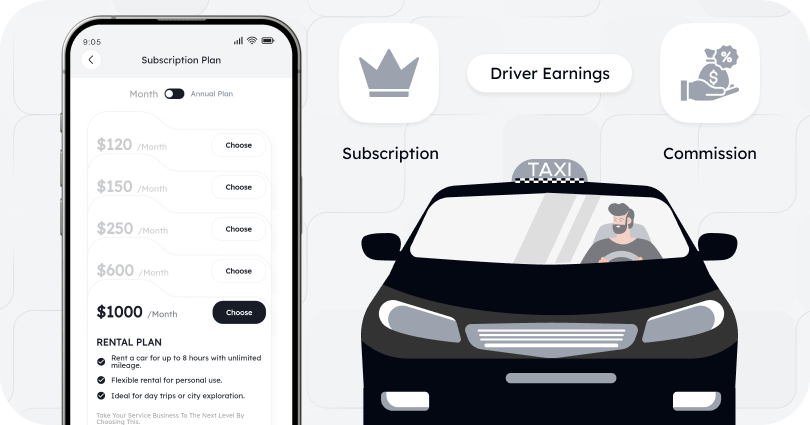
Key features of TaxiRide include: OTP login (email, phone, social), dark/light mode, multi-lingual interface, multiple services (taxi, rental, parcel, freight, ambulance), scheduling, coupon codes, wallet top-ups, and ride bidding. It also offers referral campaigns and subscription plans for drivers. The driver app supports vehicle registration, availability management, accepting/rejecting jobs, navigation (Google Maps), ride requests, and earnings withdrawal. As with Taxido, complete support ticketing and in-app chat are built-in.
Figure: TaxiRide passenger (rider) app screenshot. Users select service type and see wallet balance. TaxiRide supports ride, rental, parcel and freight bookings from one app.
TaxiRide’s tech stack is Flutter v3.38 for the mobile apps, with a Laravel v12 backend and Node.js v20 middle tier. Firebase (for FCM and social logins) and Google Maps are integrated. The admin panel is Laravel-based and can be hosted on typical LAMP or LEMP servers (similar to Taxido). It includes API endpoints for the apps and detailed documentation. Demo credentials and APK links are provided on the product page.
Pricing/licensing: TaxiRide is sold as a one-time purchase for $199 (regular license). This covers full source code. As with Taxido, you must host it yourself (the license does not include hosting or a multi-tenant SaaS). After purchase, buyers can extend support/updates via the Envato marketplace if needed.
Pros: TaxiRide’s Flutter-based apps provide smooth cross-platform performance. It supports a wide range of services (even ambulance rides) and has nice UI themes (includes light/dark mode). The code is modular – for example, services like “ambulance” or “medical” can be enabled or disabled. Frequent updates (latest May 2026) keep it current.
Cons: Like Taxido, setup requires developer work. For Flutter apps, any custom native modules will need rebuilding the APK/IPA. The out-of-the-box interface has Pixelstrap branding; you’ll need to rebrand the Flutter apps and admin for a production launch. Also, the included “subscription plans” feature is driver-side only (i.e. plans for drivers to subscribe, not for passenger passes).
Summary for TaxiRide: Flutter-based rider & driver apps plus Laravel admin, for ~$199 one-time. Rich feature set (OTP login, multiple services, chat, bidding, etc). Self-hosted deployment; no monthly fee other than hosting. Targeted at ride-hailing companies that want a turnkey white-label solution with multi-service support.
Taxiride Have a look at Taxiride
Beyond Taxido and TaxiRide, there are several leading taxi-dispatch platforms worldwide. For example, iCabbi (UK-based) is a highly configurable dispatch system used by global fleets. It promises “99.99% uptime” and handles complex bookings (multi-stop, corporate accounts, etc) with AI-assisted dispatch and voice-AI for call automation. Autocab (UK/Ireland leader since 1989) offers a feature-rich booking/dispatch suite with automated dispatch, route optimisation and integrations (e.g. live aggregators). It’s a mature platform for large fleets. TaxiCaller (Norwegian platform) is cloud-based and operates on a “pay-per-car” SaaS model. It emphasizes simplicity and reliability – e.g. claims 99.999% uptime, 24/7 support, and no lock-in contracts. Jugnoo (India) provides an end-to-end taxi software stack; it offers white-label apps, automated dispatch, route optimization and analytics. As an emerging-market platform, Jugnoo’s pricing is usage-based (e.g. per-ride fees ~ $0.075–$0.10 as part of bundled plans). Yelowsoft is another global solution that highlights AI-driven dispatch and multi-currency support (suitable for fast-growing fleets). Other notable mentions include AllRide (AI ride-sharing) and QuickRides (shuttle/concierge focus), but we won’t detail them here.
Below is a comparison table of Taxido, TaxiRide and four major alternatives. It highlights core features, typical pricing range, integrations and scalability, and ideal use-cases.
| Product | Key Features | Pricing Range | Integrations | Scalability | Ideal Use-Case |
|---|---|---|---|---|---|
| Taxido | Dispatch (rider, driver apps + admin); on-demand/scheduled rides; multi-service (taxi, rental, parcel, freight); surge-pricing; bidding; in-app wallet; multi-lang/currency. SOS and driver chat. | One-time license ~ $199 (no monthly fees); open-source code. (Hosting/API costs extra.) | Google Maps/OSM, Firebase (FCM, social login). | Scalable to small/medium fleets. (Relies on buyer’s own server scaling.) | Taxi companies wanting full-featured white-label dispatch; small-to-medium fleets needing rich features. |
| TaxiRide | Dispatch (rider, driver, admin); multi-service (taxi, rental, parcel, freight, ambulance); scheduling; coupons; driver subscriptions; live chat. Dark/Light mode, RTL, referral codes. | One-time license ~ $199. Self-hosted. | Google Maps, Firebase (FCM, social login). | Suitable for small-to-medium fleets; apps built on Flutter for easy multi-platform deployment. | On-demand taxi startups needing a polished, app-centric system; fleets that also offer parcel/freight/medical services. |
| iCabbi | Highly configurable cloud dispatch; mobile apps; voice & app-based booking; corporate accounts; AI/ML dispatch engine; “The Exchange” network for sharing jobs. 99.99% uptime and advanced analytics. | SaaS pricing (per active driver) – not published. Typical perpetual license ~$8.5k–$25k + 15% annual support. | Can integrate with phone systems, credit apps, accounting, Google Fleet Engine for AI dispatch. | Built for large fleets (hundreds+ vehicles). Handles thousands of bookings/day. | Large fleets or taxi associations requiring very robust, enterprise-grade dispatch (e.g. multi-hundred-car networks). |
| Autocab | Automated cloud dispatch; route optimisation; multi-channel booking (app, web, call); driver app; multi-OS support; corporate account portal; iGo marketplace (aggregator partnerships). | Enterprise pricing – custom quotes. (Typical closed offers.) | Integrates with third-party booking sites, IVR/VoIP, payment gateways, and many local systems. | Scales from mid-size to very large. Used by operators in 33 countries. | Traditional taxi operators (especially in UK/EU) seeking a proven, highly configurable system with aggregator connectivity. |
| TaxiCaller | Cloud dispatch (passenger app, driver app, console); real-time tracking; dynamic planning; white-label apps; caller-ID/IVR support. 99.999% uptime, 24/7 global support. | SaaS $28/vehicle/month standard (no contracts); volume discounts; free trial. | REST APIs for integration; supports VoIP and SMS; works with Stripe/PayPal etc. | Virtually unlimited (cloud). Small fleets (10–50 vehicles) especially, due to flexible pay-as-you-grow model. | Small-to-medium fleets looking for quick setup and low operational overhead (e.g. taxi startups, limo services). |
| Jugnoo | End-to-end taxi stack: rider/driver apps, dispatch console, admin; automated dispatch; route optimization; surge pricing; customizable themes; marketing tools (SMS/WhatsApp). | Bundle pricing starting at ₹6,000/mo (~$75) for 24,000 rides; pay-per-ride $0.075–$0.10. (Enterprise tiers custom.) | Integrates with payment gateways, SMS, and can be white-labeled. | Suitable for medium fleets; usage-based model handles growth. | Fleets in emerging markets or those needing affordability; also tech companies launching fleet management. |
Sources: Product websites and docs (Taxido/TaxiRide); competitor guides and reviews.
A taxi booking system’s core modules are Passenger App, Driver App, and Dispatcher/Admin. Essential features across these include:
Industry guides emphasise real-time fleet visibility and robust dispatch logic. For example, a buyer’s guide recommends “real-time fleet status on a live map” and “auto-assignment with smart fallback rules” as key features. Any solution lacking these basics is not worth considering.
Beyond the basics, “nice-to-have” enhancements include:
These advanced features should be weighed against cost and complexity. Smaller fleets may not need, for example, AI dispatch or multi-tenant setups.
Before purchasing, follow these steps:
Define Your Requirements: Document your business model (fleet size, vehicle types, booking channels, service types). Decide if you need features like airport scheduling, chat support, or particular integrations. The codico guide stresses that “each fleet type can reduce complexity, boost efficiency and scale, but the key is choosing a system that adapts to your model”. Use a questionnaire (like number of dispatchers, ride types, geographic zones) to clarify needs.
Vendor Demos and Trials: Test shortlisted platforms with your scenarios. Ask for demos of the actual software (not slides). Evaluate ease of use for drivers, dispatchers and customers. Check mobile apps on both iOS/Android.
Data Migration Plan: If replacing an existing system, plan how to import data. This includes customer accounts, driver records, tariffs, and historical bookings. As one vendor notes, a good partner will provide a “dedicated implementation and migration team” to handle data transfer with zero service disruption. Always back up legacy data and run both old/new systems in parallel for a short period.
Hosting & Deployment: Decide on on-premises vs cloud hosting. Most SaaS offerings (TaxiCaller, iCabbi) will be hosted by the vendor. For self-hosted scripts (Taxido, TaxiRide), ensure you have a server (VPS or cloud) with recommended specs (LAMP/LEMP stack, enough CPU/RAM for your fleet size). Factor in costs of servers, SSL certificates, and scalability (e.g. can you add more servers or CPU as usage grows?).
Customization & Branding: Plan any UI/branding work in advance. For example, re-skinning the passenger app and admin panel with your logo and colours usually requires either vendor services or developer time. Also check which features are ready-to-go versus which need code changes. For open-source platforms like Taxido/TaxiRide, you’ll need your tech team for any custom coding.
Staff Training: Allocate time to train dispatchers and support staff. Provide manuals or quick guides. A change to digital dispatch often faces resistance from drivers or operators used to phones – be prepared for a transition period.
Pilot Test: Launch a small-scale pilot (e.g. with a few drivers or selected area) before full rollout. Gather feedback on usability, performance and bugs.
Launch & Monitor: Go live and monitor closely: ensure bookings are routed correctly, payments clear, and any issues are fixed immediately. Use analytics to verify ROI.
The total cost of a taxi booking solution typically includes:
Software License/Subscription: Either a one-time purchase (like $199 for Taxido/TaxiRide) or an ongoing license fee. Subscription plans commonly charge per vehicle or per driver. In the US market, typical SaaS rates are roughly $40–$299 per vehicle per month. (For small fleets, TaxiCaller for example quotes ~$28/vehicle/month.) Some providers offer flat-tier pricing (e.g. up to 5 cars for a fixed fee). If you go the perpetual license route, expect an upfront cost (e.g. ~$8.5k–$25k) plus annual support fees (~15%).
One-Time Purchase: For open-source scripts (Taxido, TaxiRide), the upfront cost is low ($199) but there is no included support beyond bug fixes. You’ll need to pay for installation or custom development.
Customization & Integration: Most buyers need at least some customization (branding, UI tweaks, or new features). Hourly rates for developers vary widely (perhaps $50–$150/hr depending on region). Even basic setup (branding the apps, installing on your server) often takes several days. Fully custom features (e.g. linking to a hotel’s booking system) can cost thousands more.
Hosting & Maintenance: If using a cloud/SaaS system, your hosting is included. For self-hosted systems, budget for a reliable server. A mid-range cloud VM or VPS might cost $20–$200 per month, depending on traffic. Also factor fees for any third-party services: e.g. Google Maps API charges (free up to a point, then pay-per-use), Firebase (FCM notifications are generally free, but Firebase databases can incur costs as usage grows).
Support & Upgrades: Include any paid support or maintenance contract. Some vendors offer extended support plans for a percentage of the license. Custom builds may have a yearly maintenance (e.g. 15%).
Hidden Costs: Watch out for costs like SMS (if you use SMS OTP), payment gateway fees (typically 2–3% per transaction), and per-message charges (some dispatchers send SMS or in-app notifications per ride).
In summary, a small 10-car fleet might spend on the order of $500–$1,000 upfront for a basic system (license + initial setup) and $200–$400/month thereafter (subscription + hosting + support) on an ongoing basis. A larger fleet or one requiring many custom features could easily push the upfront cost into the $5,000–$20,000+ range (especially for custom development).
Investing in dispatch software should pay off by increasing trips and cutting costs. For example, one industry source notes that dispatch apps can automate 30–75% of bookings (through apps and web) that would otherwise go through a call centre. Automation and better routing typically reduce idle driver time and fuel costs. Reports suggest that modern dispatch systems can handle 2.2× more trips per year from app users versus only-call users.
Other ROI factors: improved customer retention (easier re-booking via app), additional revenue channels (in-app ads or premium features), and the ability to expand service area or fleet size without equivalent staffing increases. The codico analysis emphasises that “the right dispatch software cuts overhead costs, boosts profit margins, and builds long-term trust with your customers.”. In contrast, a poor software choice can cause lost revenue; one case study describes a company forced to switch platforms after six months due to missing airport-flight features, leading to client churn.
To calculate ROI, estimate the reduction in manual dispatch work (labor hours saved), the increase in bookings (from apps and web), and the revenue from new services (like parcel delivery or premium rides). Compare that to total 5-year costs of the system. As a rough benchmark, if dispatch software can even boost utilization by 10–20%, it typically justifies its cost quickly.
Switching systems is a critical step. To minimize disruption:
A smooth migration typically involves 2–4 weeks of overlap, testing, and fine-tuning. Having vendor or consultant support during this phase can be very valuable.
Choosing the best taxi booking platform involves balancing features, cost, and long-term business fit. Taxido and TaxiRide (profiled above) offer comprehensive, ready-built systems at modest upfront costs – ideal for operators who want control and customization. Major competitors like iCabbi, Autocab or TaxiCaller deliver cloud-hosted solutions with enterprise features and support, often at higher ongoing cost. Use the feature comparisons and buyer’s checklist in this guide to match the software to your fleet’s needs and budget. With the right choice, a taxi dispatch platform can transform operations – improving efficiency, customer satisfaction and profitability well beyond its cost.
Sources: Industry market reports; official product/documentation for Taxido and TaxiRide; taxi-dispatch reviews and guides.